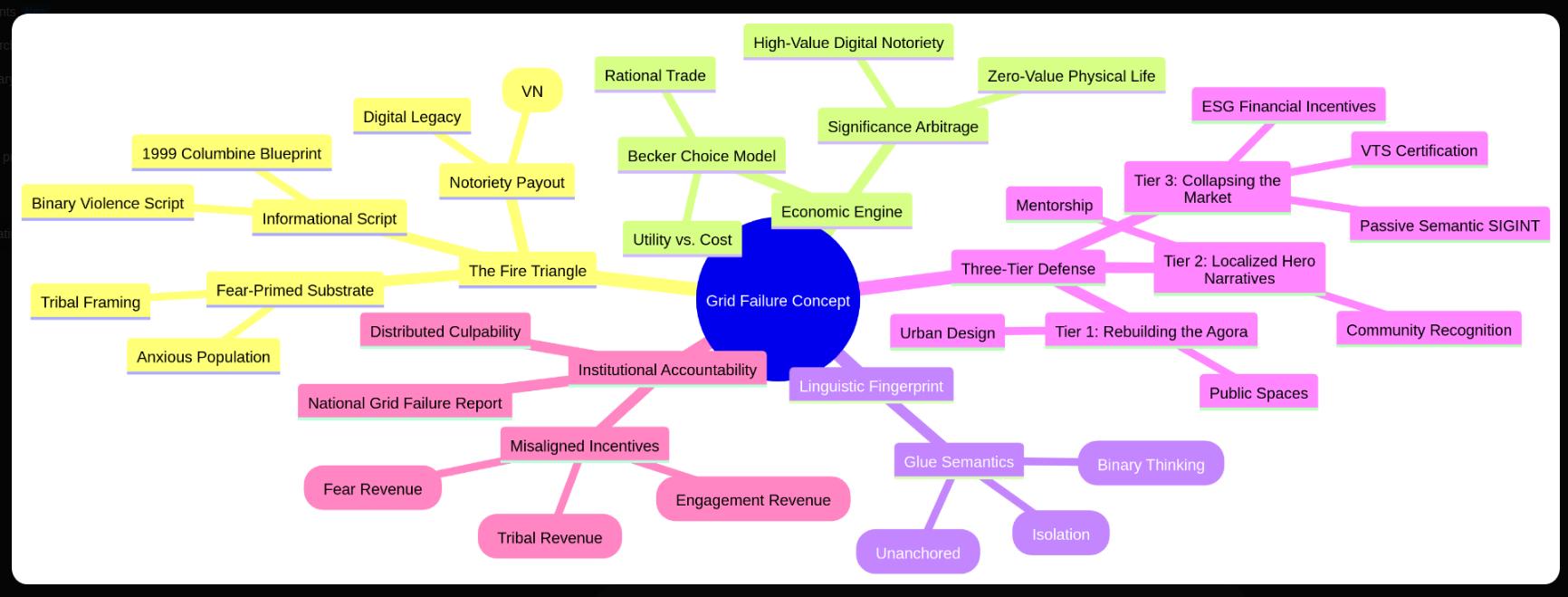
Why Does Mass Violence Keep Happening?
The chain of Significance Arbitrage breaks when we restore local bonds and collapse the digital reward.

A mother sits in her car in the school parking lot. It is Tuesday morning. She should be thinking about the grocery list or her afternoon meetings. Instead, she stares at the brick facade and feels nothing. The fear has gone quiet. What remains is heavier. The cycle has repeated so often her mind went quiet to survive it. Her children are inside. She loves them.
We ask why the killing continues. We look at the final minute of the crisis and demand a solution. We debate the weapon. The weapon is the final link in a chain that begins years before the first shot. The instrument is a tool of efficiency. The mandate originates in social isolation. Targeting the instrument addresses only the terminal stage of the collapse. Prevention requires interrupting the informational drive at its source.
The path begins when a person loses their tether to local community. They enter a state of digital drift. There they discover a ready-made script of violence. The digital archive offers a trade. It promises that a single act can replace a life of zero significance with a legacy of permanent visibility. He trades a physical life for digital notoriety. This is Significance Arbitrage. It is a calculated move. When local bonds fail to provide a sense of place, the digital network provides a story.
The perpetrator is a rational actor seeking the only reward his environment still offers. We can interrupt this chain. The structural remedy operates above the hardware level. This hardware-agnostic approach collapses the trade by restoring physical presence and removing the digital reward. The mother in the school parking lot deserves a world where the tethers hold her children long before they reach the door.
Practice the No Notoriety protocol today by refusing to share, search for, or repeat the name of any perpetrator.
Read the full economic framework: Notoriety Arbitrage (DiBella, 2026).
Glossary
Digital Drift: The psychological migration from local physical community to isolated digital scripts.
Hardware-Agnostic: Solutions that operate independently of the specific instrument used in an event.
Reference Citations
DiBella, C. J. (2026). Notoriety Arbitrage: Informational Incentives in Violent Acts. SSRN.
Notoriety Arbitrage Series | Post 1 of 15
To provide a fair estimate of who could fully comprehend the "Notoriety Arbitrage" framework, one must account for its extreme interdisciplinary density. The sources draw from Information Theory, Behavioral Economics, Economic Sociology, High-Reliability Engineering, and Post-Structuralist Philosophy.
Estimated Understanding: Global vs. Targeted Populations
-
Global Population (1 in 10K): This is likely an accurate, if not slightly generous, estimate for those capable of a deep, synthetic understanding of the entire argument. Beyond the language barrier (English), the paper requires the reader to simultaneously process concepts like the Becker Choice Model (Economics), Glue Semantics (Linguistics), and the Swiss Cheese model of engineering. While many might understand the "gist" of it, that social media fuels violence, the specific "mechanics of the arbitrage trade" require a rare level of academic literacy.
-
University-Educated English Speakers: Within this subset, the ratio would be significantly higher, perhaps 1 in 100 to 1 in 500. However, because the framework rejects the standard "individual pathology" model in favor of a "Grid Failure" model, it requires unlearning 25 years of dominant psychological profiling. Only those comfortable with multi-factorial synthesis and "structural porosity" will truly grasp the prescriptive layers of the Deep Defense Architecture.
Scalar Rating of Scope and Depth
On a scale of 1 to 10, where 10 represents the highest possible level of intellectual synthesis:
-
Scope: 10/10. The argument is historically and disciplinarily vast. It traces the "intellectual architecture" of violence from Aristotle’s polis (350 BCE) to the 2012 Operational Saturation of algorithmic feeds. It attempts to explain not just a single act, but a global phase transition in how human significance is produced and archived.
-
Depth: 9/10. The paper does not merely describe the problem; it provides a formal causal model. It dives into "unconscious functor distribution" (Glue-Drift) and "macroprudential yield recalibration," moving far beneath the surface-level debates about hardware or mental health.
The Existential Importance
The sources frame this issue as a terminal technological condition. The argument posits that:
-
The Social Anchor (community/family) has been eroding for 50 years, creating a "significance vacuum".
-
The 1999 Informational Inflection turned mass violence into a "permanent searchable digital archive," providing a "ready-made script" for those in "Total Drift".
-
We are in a narrow window for structural repair before the divergence from social stability becomes irreversible.
The "existential importance" lies in the claim that violence is now an informational transaction. If the "digital payout" of notoriety is not collapsed, the "Significance Arbitrage" mechanism will continue to find receptive actors as long as the "grid" remains porous.
Listen: Trading Life for Digital Notoriety
Analysis: Trading Life for Digital Notoriety
This document provides a comprehensive analysis of the audio content titled "Trading Life for Digital Notoriety," which discusses a 2026 working paper by independent researcher Charles J. DiBella titled "Notoriety Arbitrage: Informational Incentives in Violent Acts." The discussion reframes mass violence not as individual psychological pathology, but as a systemic "grid failure" driven by informational and structural incentives.
1. Ordered List of Facts
The following facts are presented as the empirical and structural basis for DiBella's framework:
-
Research Source: The discussion is based on a 2026 working paper by Charles J. DiBella titled "Notoriety Arbitrage: Informational Incentives in Violent Acts."
-
Historical Context: For approximately 25 years, society has primarily used the "psychological autopsy" to understand mass violence, focusing on individual mental health.
-
Economic Model: DiBella applies the Becker Choice Model (Gary Becker, 1968) to analyze violent acts as rational trades based on utility and cost.
-
Linguistic Markers: Research by James W. Pennebaker identifies "glue words" (functors like pronouns and prepositions) as unconscious indicators of psychological state.
-
The "Glue Drift Signature": Three specific linguistic markers correlate with social isolation and cognitive collapse:
- I-word spike: Increase in first-person singular pronouns (I, me, my).
- We-word collapse: Decrease in first-person plural pronouns (we, us, our).
- Exclusive word drop: Decrease in words indicating complexity (but, except, without).
-
Hardware Agnostic Corollary: Data from the 2018 Toronto van attack and the 2016 Sagamihara knife attack show that the same "informational script" persists regardless of the weapon used (firearms, vehicles, or knives).
-
Legal Frameworks: Section 230 (USA) and the Digital Services Act (EU) provide legal immunity to platforms for user-generated content, making statutory censorship difficult.
-
Empirical Case Studies: Japan and Sweden maintain near-zero rates of performative mass violence despite having modern digital infrastructure, attributed to "high-friction reporting norms."
-
Civic Movements: The "No Notoriety" movement (founded by Tom and Karen Teves) and judicial precedents (e.g., Justice Anne Malloy's refusal to name the Toronto attacker) are active efforts to deny notoriety.
2. List of Assumptions
The framework relies on several key assumptions regarding human behavior and systemic influence:
-
Rationality of the Irrational: It assumes that even horrific acts of violence can be modeled as a rational choice where the perpetrator weighs perceived utility against cost.
-
Zero-Value Life: It assumes that perpetrators reach a state of "social bankruptcy" where their physical life has zero perceived value, making the "cost" of the act negligible.
-
Digital Legacy as Utility: It assumes that the promise of a permanent digital legacy (Visibility/VN) is a powerful enough incentive to outweigh the cost of death or life imprisonment.
-
Predictability of Language: It assumes that unconscious linguistic patterns are more reliable predictors of behavior than conscious ideological statements.
-
Effectiveness of Friction: It assumes that by increasing the "friction" of achieving notoriety (e.g., through algorithmic demotion), the incentive for the act will collapse.
-
Institutional Malice/Negligence: It assumes that media, tech platforms, and politicians have misaligned incentives that cause them to profit from the "grid failure" rather than fixing it.
3. List of Assertions
The speakers and DiBella make the following bold claims:
-
Mass Violence is a Grid Failure: Mass violence should be treated as a systemic architectural collapse of the informational grid, not a series of isolated psychological mysteries.
-
Significance Arbitrage: The core mechanism of modern mass violence is "significance arbitrage"—trading a zero-value physical life for a high-value digital notoriety.
-
The Script is the Driver: The "informational script" (the 1999 Columbine-style blueprint) is the causal driver of these events; the hardware (weapons) is a secondary operational variable.
-
The "Fire Triangle" of Violence: Violence requires three components: a Fear-Primed Substrate (anxious population), an Informational Script (the blueprint), and a Notoriety Payout (the reward).
-
Censorship is Unnecessary: We do not need new censorship laws; we can collapse the notoriety market through market-based incentives (e.g., ESG funding tied to "Anchor Safety Certification").
-
Distributed Culpability: Accountability for tragedies should be distributed across the nine institutional layers that failed to provide "anchors," rather than solely on the perpetrator.
-
Grid Failure is a Revenue Condition: The current system persists because the actors with the power to fix it (media, tech, politicians) actively profit from the fear and engagement generated by the failure.
4. Outline Overview
I. Introduction: The Power Grid Analogy
- Reframing mass violence from "individual pathology" to "structural grid failure."
- The failure of the 25-year "psychological autopsy" model.
II. The Economic Engine: Significance Arbitrage
- The Becker Choice Model: Weighing utility vs. cost.
- The Ledger: Trading a "bankrupt" physical life for an "exponential" digital legacy (VN).
- Fame vs. Significance: The desire for a permanent alteration of the historical record.
III. The Linguistic Fingerprint: Glue Semantics
- James Pennebaker's Research: The power of "functors" (glue words).
- The Glue Drift Signature: I-word spikes, We-word collapses, and Exclusive word drops as predictors of "anchor decay."
IV. The Hardware Agnostic Corollary
- The "Script" as the primary driver; weapons as secondary tools.
- Case studies: Toronto (van), Sagamihara (knives), and the persistence of the 1999 script.
V. The Defense Architecture: The Three Tiers
- Tier 1: Rebuilding the Agora: Urban design and public spaces to reduce "digital drift."
- Tier 2: Localized Hero Narratives: Mentorship and community recognition to provide "anchors."
- Tier 3: Collapsing the Notoriety Market:
- Voluntary Transparency Standards (VTS).
- ESG-linked financial incentives for platforms.
- Passive Semantic SIGINT for early warning.
VI. Conclusion: The Political Economy of Failure
- Why the grid remains broken: The monetization of fear, engagement, and tribalism.
- The shift from "Psychological Autopsy" to "National Grid Failure Report."
- The final question: Are we tending our anchors or are we drifting?